Reviewed by Hamza, Avian Care Lead at Dubai Birds since 2018
Cockatiels are the UAE's most popular hand-raised starter parrot, small enough for an apartment, calm enough for first-time owners, and long-lived enough to be a 15-20 year commitment. This guide is the complete care brief our team gives every cockatiel buyer at the Warsan 3 aviary, with Dubai-specific notes on heat, AC airflow, and where to find the diet ingredients that actually keep a cockatiel healthy.
_Last reviewed: May 2026_
The cockatiel (Nymphicus hollandicus) is the most-recommended first parrot at Dubai Birds. They are small, quiet enough for a Dubai apartment, easy to hand-tame, eat a diet you can buy at any UAE supermarket, and live long enough to genuinely become a member of the household. They are also routinely under-cared-for in the UAE because the "starter bird" framing makes new owners think the commitment is small. It isn't. A cockatiel bought today will likely still be alive in 2041.
This guide is the same brief our team walks every cockatiel buyer through at our Warsan 3 aviary. Use it before you buy, during the first week at home, and as a reference whenever something looks off.
Native habitat and origin
Cockatiels are native to the dry inland scrubland and woodland of Australia, where they live in nomadic flocks that follow seasonal water and seeding-grass availability. They are the smallest member of the cockatoo family, close cousins to galahs and umbrella cockatoos rather than to the African and South American parrots they're often grouped with. The wild cockatiel diet is dominated by grass seeds; pet diets that mirror this exclusively (a 100 % seed bowl) cause the obesity, fatty liver disease, and Vitamin A deficiency we see most frequently in UAE-raised cockatiels.
Every cockatiel sold legitimately in the UAE is captive-bred. The wild-caught trade is irrelevant to this species, domesticated cockatiel breeding has been continuous since the 1840s, and the birds available today are many generations removed from wild ancestors.
Lifespan, size, weight
Lifespan: 15-20 years in captivity with proper care. The oldest verified cockatiels lived past 28 years.
Length: 30-33 cm including the long tail (the tail is roughly half the bird).
Weight: 80-110 g for a healthy adult. Birds over 130 g are typically obese.
Wingspan: approximately 30 cm.
Sexual maturity: 9-12 months, sometimes earlier in well-fed birds.
A cockatiel purchased at 4-6 months in 2026 will likely still be alive when the buyer's children are starting university. Plan accordingly, including who in the household will care for the bird if circumstances change.
Mutations and what they look like
Cockatiels have been selectively bred since the 1950s into a wide range of colour mutations. The main ones you'll see at Dubai Birds:
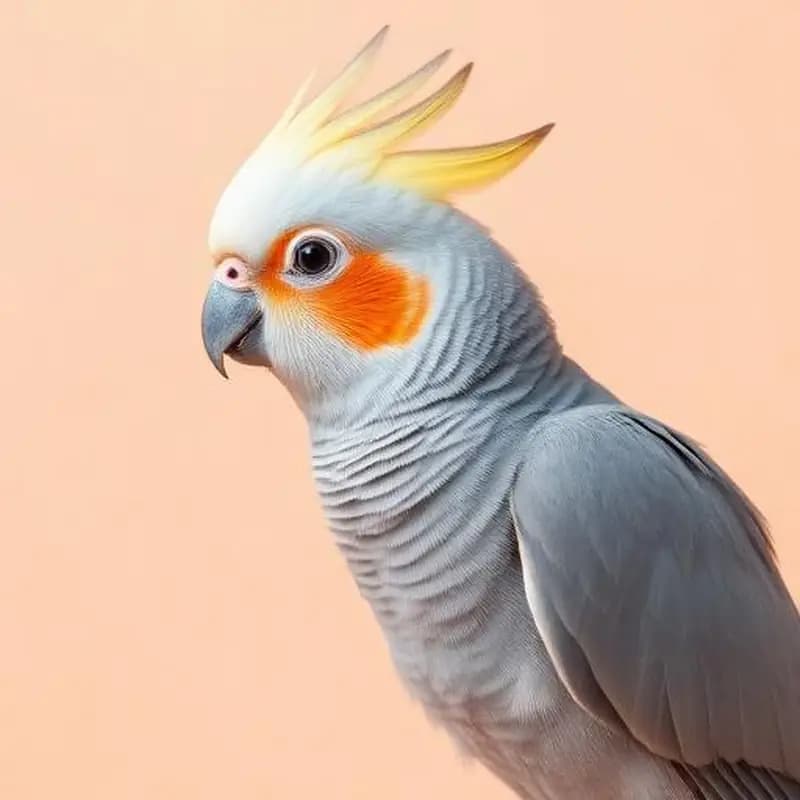
Grey (wild-type). The original colouring, grey body, white wing flash, orange cheek patch, yellow head and crest in males. Hardiest of all the mutations.
Lutino. Yellow-and-white body with the red-orange cheek patch retained. The most popular mutation in the UAE. Lutinos are sometimes prone to a small bald patch behind the crest from a genetic linkage.
Pearl. Scalloped white-and-grey patterning across the back and wings. Females retain the pattern for life; males often fade to plain grey after their first moult.
Cinnamon. Like grey but with brown replacing the black pigments, a softer, warm-toned bird.
Pied. Random white patches on the standard grey body.
White-Faced. No yellow, no orange cheek, a stark grey-and-white bird with a much more "exotic" look. Usually priced higher.
Bronze Fallow / Dominant Silver / Dominant Yellow Cheek. Less common combinations bred for collector interest.
Mutation does not affect lifespan or health if the breeder pairs responsibly. It does affect price, Lutino and Pearl are typically near the catalogue floor; rarer mutations like White-Faced or Dominant Silver run higher. See current AED ranges at [bird-prices-uae](https://dubaibirds.ae/bird-prices-uae/).
Temperament, what to actually expect
Calm and gentle. Cockatiels are not nippy birds when properly hand-raised. A bonded cockatiel will fall asleep on a shoulder and stay there for an hour.
Whistlers more than talkers. Most cockatiels learn to whistle tunes (the Andy Griffith theme is a staple) but only some learn words. Males are more vocal than females. If you specifically want a talking parrot, an [African Grey](https://dubaibirds.ae/bird-care/african-grey-care/) or Indian Ring Neck is a better match.
Flock-bonding. Cockatiels are flock animals. A single bird kept alone needs 4-6 hours of human interaction every day to thrive; pairs bonded as juveniles bond with each other primarily and with humans secondarily.
Apartment-suitable noise level. A male cockatiel's morning and evening "chorus" is loud for the species but quiet by parrot standards, well within tolerable range for JLT, Marina, Downtown, or villa life.
Night frights. Cockatiels are uniquely prone to night-frights, sudden flapping panic in a dark cage, often triggered by a passing car light or unfamiliar sound. Use a small night light near the cage to break the panic cycle. This is not a sign of an unhealthy bird; it's a species trait.
Diet, UAE-specific
A wild cockatiel eats grass seeds, sprouts, fresh greens, and the occasional insect. A pet cockatiel in Dubai will not eat any of those naturally, so the work is on the owner.
Daily plate (adult cockatiel, ~95 g body weight)
160-70 % high-quality pellets, Harrison's, Roudybush, ZuPreem Natural, or Tops. Buy from Pet's Delight (Mall of the Emirates / multiple branches) or DubaiPetFood online. Avoid colourful "pet store seed mixes" sold as pellets, most are extruded seed dust with sugar coating.
225-30 % chopped fresh vegetables, heavy on dark leafy greens (kale, spinach, romaine) and orange/red veg (carrot, sweet potato, capsicum) for Vitamin A. Add small amounts of broccoli, cauliflower, courgette, peas. Stocked year-round at Carrefour, Spinneys, Waitrose, and Union Coop.
35 % fruit, apple (no seeds), berries, pomegranate, mango, papaya. Fruit is sugar, treat it as a treat, not a staple.
4Small daily seed mix as a top-up, a heaping teaspoon of millet, canary grass, and sunflower (sparingly, sunflower is fatty). Seed should be 5-10 % of total diet, not the foundation.
5Cuttlebone clipped inside the cage at all times. Refresh every 8-10 weeks.
Foods to avoid
Avocado, toxic to all parrots, including cockatiels.
Chocolate, caffeine, alcohol, fatal in small doses.
Onion, garlic, raw potato, raw mushroom.
Apple seeds, cherry pits, peach pits, cyanide compounds.
Salt, sugar, fried foods, dairy.
Soft food left out for more than two hours in summer (May-September). Even with AC running, ambient indoor temperatures in Dubai apartments often touch 28 °C in afternoons; bacterial growth on chopped fruit and veg is rapid. Pull uneaten fresh food after 90 minutes.
Why an all-seed diet is the most common cockatiel killer in the UAE
The single most common cause of premature cockatiel death we see at Dubai Birds is owners who fed seed-only for years. Symptoms accumulate slowly: dull feathers, fatty deposits visible under the skin near the keel bone, breathing-on-exertion, and eventually heart and liver failure. The bird looks "fine" until it isn't. If your bird has been on seed-only for more than six months, transition gradually, full pellet conversion in 2-3 weeks by mixing into the seed bowl in increasing ratios, and book an avian vet check.
Housing in UAE climate
Cage requirements
Minimum dimensions: 60 cm wide x 50 cm deep x 70 cm tall for one bird; 80 x 50 x 80 cm for two. Bigger is always better. A cage smaller than the minimum forces feather damage on the tail and stresses a flighted species.
Bar spacing: 1.5-2 cm. Wider bars let a cockatiel get its head stuck.
Bar gauge: stainless steel or powder-coated steel only. Zinc and lead are toxic to all parrots and cause slow chronic poisoning.
Perches: 3-4 perches at varied diameters (1-2 cm) and natural-wood textures. Replace dowel perches that come with most starter cages, the consistent diameter causes pressure sores ("bumblefoot") within months.
UAE-specific climate setup
1Indoor temperature: 22-26 °C. Cockatiels tolerate 18-30 °C briefly but stress outside that band, and prolonged heat above 30 °C is dangerous.
2AC airflow: never directly on the cage. Cold air from a split AC unit at full blast causes respiratory infection in days, not weeks. Position the cage at right-angles to the air flow, not in front of the vent.
3Humidity: 50-60 %. Dubai indoor air with AC running often drops to 25-35 %. Persistent low humidity dries feathers, irritates sinuses, and causes excess powder-down dust. A small cool-mist humidifier solves this.
4Light: 10-12 hours of daylight, 10-12 hours of full darkness. Cover the cage at night. Inconsistent dark periods trigger hormonal egg-laying in females and aggression in males.
5Balcony placement: only with shade, only before 9 a.m. or after 5 p.m. Direct UAE summer sun through a balcony window heats a cage to 50 °C in 20 minutes, fatal in less than an hour. Power outages in summer are an emergency; have a battery-powered fan as backup.
6Air quality: never use Teflon/PTFE non-stick cookware in the same airspace. PTFE fumes kill cockatiels in minutes. Avoid scented candles, aerosol deodorant, plug-in air fresheners, oven-cleaning sprays, hairspray, and shisha smoke near the cage.
7Night frights mitigation: a small dim night light (a wall plug-in nightlight or an under-cabinet LED on a timer) reduces the frequency of panic episodes substantially.
Daily routine and enrichment
A single cockatiel needs 3-5 hours per day out of the cage and at least 1-2 hours of structured human interaction. A bonded pair needs less human time but more enrichment to avoid territorial behaviour.
Morning: open the cage, fresh food, 15 minutes of shoulder time.
Midday: independent play in a play-stand or on a perch, foot toys, paper-shredding boxes.
Afternoon: training session, whistled tune, step-up command, target training. 5-10 minutes is enough; cockatiel attention spans are short.
Evening: family social time. Cockatiels want to be in the room, not stared at across it.
Night: 10-12 hours of darkness in a covered cage, with a dim night light to break panic episodes.
Rotate at least 4 toys weekly. Foraging puzzles, shreddable paper, untreated leather strips, and natural wood blocks are well-priced and effective. Cockatiels deprived of stimulation pluck their chest feathers within a few months, and once it starts it is very hard to stop.
Common health issues we see in UAE cockatiels
In approximate order of frequency at Dubai Birds:
1Obesity and fatty liver disease. Caused by all-seed or seed-heavy diet over years. Prevention: 60-70 % pellets from year one.
2Vitamin A deficiency. Sinus infections, dull feathers, pasted eyes. Prevention: orange and dark-green vegetables daily.
3Egg binding (females only). A reproductively active female can become egg-bound, a life-threatening emergency. Reduce risk by keeping daylight at a strict 10-12 hour ceiling, removing nest-like cavities (closed huts and dark corners), and not pair-housing if you don't want chicks.
4Respiratory infection. From AC blast directly on cage, or from low humidity. Prevention: AC positioning + 50-60 % humidity.
5Feather plucking. Boredom, low humidity, hormonal frustration, undiagnosed infection. Treat as a medical emergency: book an avian vet, raise humidity, double the bird's foraging enrichment.
6PTFE poisoning. Sudden death from non-stick cookware fumes. Strict avoidance is the only prevention.
For warning signs, see our [recommended avian vets list](https://dubaibirds.ae/vet-partners/) and message us on WhatsApp first if you're not sure whether a symptom is urgent, we can often triage by photo or short video.
Where to buy in the UAE, what to ask any seller
Cockatiels are the easiest exotic bird to source legally in the UAE. They are not CITES-listed, so the documentation burden is light. That doesn't mean the source is unimportant. The questions to ask any UAE seller:
1Hand-raised or parent-raised? Hand-raised cockatiels are bottle-fed by humans from 2-3 weeks old and tame to handling. Parent-raised cockatiels are healthier physically but rarely tame. Hand-raised is the right call for a pet bird.
2**Fully weaned?** Cockatiels wean at 8-10 weeks. A bird sold "for hand-feeding" before that age is a high-risk purchase, aspiration pneumonia is a real possibility for inexperienced hand-feeders. Buy fully weaned.
3Vet-checked? A pre-sale vet check by a UAE-licensed avian vet, body weight, faecal exam, beak/cere/eye/nare check, is the floor for a legitimate seller.
4**Closed leg ring or microchip?** Captive-bred indicator. Most cockatiel breeders ring chicks at 7-14 days.
5Breeder name and contact? A real breeder is reachable for life-of-bird advice. If a seller can't tell you which breeder a specific bird came from, walk away.
6Mutation honestly stated? Pearl males will fade; some "rare" mutations are mis-sold. Compare against this guide.
For our sourcing protocol see the [breeder network page](https://dubaibirds.ae/breeder-network/). For the legal context behind every UAE bird sale see the [UAE exotic bird ownership laws guide](https://dubaibirds.ae/uae-exotic-bird-laws/).
Hand-raised vs imported
UAE-bred, UAE-raised cockatiels adapt fastest to local climate, food brands, and household routines. Recently imported birds need 4-6 weeks of acclimatisation. At Dubai Birds we prioritise UAE-bred cockatiels, see current availability at [shop-birds/cockatiels](https://dubaibirds.ae/shop-birds/cockatiels/).
AED price ranges in 2026
Hand-raised, fully weaned, vet-checked cockatiels at Dubai Birds typically start at AED 700. Mutation colour is the main price variable, Lutino, Pearl, Cinnamon, and Bronze Fallow are clustered close to the floor; White-Faced and Dominant Silver run higher. For live AED ranges across all the cockatiel mutations we have in stock right now, see the [live price guide](https://dubaibirds.ae/bird-prices-uae/).
A note on second-bird math: if you're considering pair-housing, the second cockatiel doesn't need to be the same mutation. Cockatiels bond to other cockatiels regardless of colour.
Reviewed by
Reviewed by Hamza, Avian Care Lead at Dubai Birds since 2018.
Yes. Cockatiels are not CITES-listed, so they don't require CITES paperwork. A standard veterinary health certificate from the seller is enough for legal ownership. The broader animal-welfare obligations under Federal Law 16/2007 still apply, appropriate cage, food, water, and veterinary care.
Can a cockatiel live in a Dubai apartment?
Yes, cockatiels are one of the few hand-raised parrots well-suited to UAE apartment life. They're quiet by parrot standards and tolerate the indoor climate range that AC produces, provided the cage isn't in direct AC airflow. We've placed cockatiels successfully in JLT, Marina, Downtown, Business Bay, and similar high-density buildings.
How long does it take a cockatiel to start whistling?
Most start mimicking sounds at 4-6 months and learn short tunes by 8-12 months. Males are more reliably vocal than females. Some never whistle complex tunes, that's species-normal, not a fault. If you specifically want a talking parrot, see our African Grey care guide or consider an Indian Ring Neck.
Are male or female cockatiels better as pets?
Both are good, but they have different traits. Males are more vocal, they whistle, mimic, and chorus at sunrise and sunset. Females are quieter and tend to bond more equally to multiple humans in the household. Hormonally, females have egg-binding risk; males have territorial display behaviour during breeding season. For a single-bird household, either works.
Do I need to clip my cockatiel's wings?
We don't recommend wing-clipping as a default. A flighted cockatiel exercises better, balances better, and tends to be psychologically healthier. Clipping is appropriate in specific circumstances, multi-pet households where a flighted bird could land on a dog or cat, or apartments with dangerous architecture (open kitchen flames, large unprotected windows). Talk to an avian vet before deciding; clipping is reversible at the next moult but trauma from a botched clip is not.
My cockatiel is plucking its feathers, what do I do?
Treat plucking as a medical emergency rather than a behavioural quirk. Book an avian vet from our recommended vets list the same week. While you wait: raise indoor humidity to 55-60 %, remove anything new in the bird's environment that might be triggering hormonal stress (new mirrors, new dark cavities, new household members), and double the foraging enrichment. WhatsApp us a video, the pattern of the plucking sometimes points to the cause.
How often should my cockatiel see a vet?
An annual wellness check from year one is the standard. Add a 30-day post-purchase check for new owners, the first month catches the issues that show up after a household move (stress shedding, mild GI upset, picky eating). For warning signs, see our recommended avian vets list.
Can I keep a cockatiel and a budgerigar together?
Not in the same cage. Cockatiels are noticeably larger and can injure a budgie even in play. They can free-fly together in the same room under supervision if both birds are calm, but each needs its own cage as a home base.
What's the difference between a cockatiel and a small cockatoo?
The cockatiel is technically the smallest cockatoo, same family (Cacatuidae), same crest behaviour, same powder-down feathers. The practical differences: cockatiels are 30 cm and 95 g; the smallest "real" cockatoo (Goffin's) is 32 cm and 250 g. Real cockatoos need significantly more space, more enrichment, and produce far more noise. A cockatiel is a sensible first cockatoo-family bird; an Umbrella or Moluccan is a 30-year emotional commitment we don't recommend to first-time owners.
How much does ongoing care cost per month for a cockatiel in Dubai?
Roughly AED 80-150 per month for food and consumables (pellets, fresh produce, cuttlebone, paper for foraging). Annual avian vet check is typically AED 200-400. New cage and accessories run AED 300-600 every few years. The bird is the cheapest part of ownership.
Do cockatiels need a friend, or can they live alone?
They prefer company, they're flock animals. A single cockatiel can be perfectly happy if a human household member is home for at least 4-6 hours a day with active interaction. If the household is empty most of the day, two cockatiels are kinder. Note that pair-bonded birds tame less to humans, so the trade-off is real.